Japan
Chronicles of four education majors from the University of Calgary heading into Japan for an adventure.
Thursday, June 2, 2011
Maple School
Today our team visited a small rural school called the Maple school, it got its name because of all the maple tree's in the surrounding area. The school has 18 students in grade 1 to grade 6. The school is beautiful in design and function with a large gym shaped like a barn. The students were shy at first, which seems to normal for Japanese students, but warmed up after we had lunch and started to play the game we brought for them to learn. The game we brought from Canada was "What time is it mr Wolf" a classic school yard game that we adapted for Hokkaido by changing it to Mr Bear. The children were quick to join in and have fun. Its still amazing to me that a group of Canadians with limited to no Japanese language can still connect so much with a group of students. When we were leaving the school they wanted to have a photo with us all on the steps of the school, another wonderful memory from Hokkaido to bring back to Canada. Our time is almost over here in Japan, its bitter sweet thinking about leaving. Bitter because of not having the time to see and taste and experience so many of the wonders of this country but at the same time sweet because of the great friends I have made and the amazing students I have been privileged to meet and teach. I look forward to seeing my friends and family in Canada and telling them about the incredible time I have had here in Japan.
Jon
Jon
Wednesday, June 1, 2011
Hands up if you like chocolate!
On Wednesday we visited a Sapporo Landmark...The Chocolate Factory. I can only imagine that as you read the words `Chocolate Factory` you were automatically reverted to `Charlie and The Chocolate Factory` and the ever amazing Willie Wonka. If you weren`t, this is fair warning that I was...

We walked past a chocolate cafe where you can buy pieces of cakes, cookies or pure chocolate itself..across from the cafe there was a grand piano...it was playing a beautiful song without a musician. Hina enjoyed this the most...she stared in awe as the keys moved independently...
She played her own invisible piano on the train ride home....

At the end of the tour we went outside with some of the goodies we had bought to devour them in the sunshine...
Hina and I `cheersed` over a can of super thick, rich chocolate milk...
YUM!
We had lunch across the street over looking the mountain range and soccer field...afterwards we decided we should go souvenir shopping...we came to a shop that I`m almost certain sold everything you could ever desire....
As we walked down the side walk, a sign appeared on the horizon the let us know we were heading in the right direction* `Chocolate Factory`...there in the middle of a mountain range was a magical place that we couldn't`t wait to explore and taste...soon enough the sweet scent of chocolate filled the air and our mouths were salivating. The smell was so intoxicating that I wish I could have bottled it up and brought it home to share with you..I have never smelled something quite like this...rich, creamy and irresistible...

Inside the gates the magic truly began to come to life. As the four five of us (we had the pleasure to be joined by Hina, Sylvia`s home stay sister) passed through the gates we were immediately greeted not only by the smell of chocolate and flowers but our other senses were exercised as well. There were flowers and gardens as far as you could see, tiny houses, bright sunshine, beautiful wrought iron canopies...even a tree house. A train circled around the courtyard for children to ride and squeal with pleasure. A show was beginning-the spectacle was full of energy and enthusiasm as figurines danced and twirled above our heads welcoming us. People stood in awe, grinning from ear to ear at the sight before them.
When the show had ended, we wandered through the tiny houses, took our photos by a hillside of flowers and decided it was time to see what the factory had to offer inside- again we were warmly welcomed as we paid for our tickets. Iron dog footprints lead us on our tour. We would stop and watch as chocolate cookies were made-the workers moving with precision. It was a sight to see. Everything within the factory was decorated in celebration of the work that took place there...there were figurines above the heads of the workers of children and animals who loved chocolate and were excited to be a part of the magic. We would walk through hallways that were decorated with fancy gold plating and special antiques...there were toys museums, music museums, hot chocolate cup museums, chocolate container museums, chocolate labelling and advertising museums...it was unreal.
Near the end of the tour, we came across a table of boutonnieres and tiny cakes...as we got closer we noticed that they were made of chocolate and sugar....they are made by hand each day-it
would have taken so much patience from the person responsible for them because there were
hundreds of tiny globes, each containing a beautiful piece of art.
Near the end of the tour, we came across a table of boutonnieres and tiny cakes...as we got closer we noticed that they were made of chocolate and sugar....they are made by hand each day-it
would have taken so much patience from the person responsible for them because there were
hundreds of tiny globes, each containing a beautiful piece of art.
We walked past a chocolate cafe where you can buy pieces of cakes, cookies or pure chocolate itself..across from the cafe there was a grand piano...it was playing a beautiful song without a musician. Hina enjoyed this the most...she stared in awe as the keys moved independently...
She played her own invisible piano on the train ride home....
At the end of the tour we went outside with some of the goodies we had bought to devour them in the sunshine...
Hina and I `cheersed` over a can of super thick, rich chocolate milk...
YUM!
We had lunch across the street over looking the mountain range and soccer field...afterwards we decided we should go souvenir shopping...we came to a shop that I`m almost certain sold everything you could ever desire....
We walked into the store and sure enough, we were right...you can find ANYTHING here...including a crab hat...

One Week...
As our time in Japan speeds toward the end, I find myself thinking about everything I wanted to do while I was here. I begin reminiscing about one afternoon a week or so before getting on the airplane to come here and I was sitting on my bed thinking about all the magical, wonderful things I would get to do, see, hear and taste while I was away in Japan. Many of the excursions I wanted to do and things I wanted to see I had only heard about in movies and magazines. I began compiling a mental list:
Cherry Blossom Festival
Fish Market
Ainu Cultural Museum
Otaru, flower festival and pottery shops
Shinto Temple
Downtown Sapporo
Sapporo Station
The Train
Onsen (preferably with monkeys...lol...)
Outdoor Markets and Shops
Royce Chocolate Factory
Sapporo Chocolate Factory
Beer Museum/ Factory
Traditional Japanese Dance
Kimono Lessons
Cooking Lessons
etc...
Some of the above list was added after arrival...most has been completed and experienced...some has not...Even though I had compiled the majority of this list before departure, due to miscalculations of time and how quickly it would go by, there are things on my list that remain *Un-checked*...As we sat around chit chatting after class in the international room, panic set in for the four of us realizing that our time was now very limited. We had one weekend left here to explore and create memories. I knew that I would not fit everything that I wanted to do into my remaining time and so, my list began to dwindle. As I cut out the `not as importants` and focused on the `oh my word super importants,` I began to question why it really mattered to me what I did while I was here. I think that the true importance is how I felt, what I learned and what I can take home with me via memory...Not the photo`s, souvenir`s or brochures of places I have been.
The value of this trip for me has been insurmountable. I have enjoyed my time of immersion in another culture surrounded by new and exciting things. I have made so many memories that I will cherish forever...but most importantly, I have acquired so much new found knowledge through my short period in Japan...
...hmmm KNOWLEDGE...
I find it interesting that the opportunity to visit Japan was presented to me because I am a student of the faculty of Education at the University of Calgary...the reason I say this is because my time in Japan serves as a metaphor for teaching...Often times I have heard an educator say `Oh I just don`t have enough time to cover everything I wanted to`...well, neither have I...the parallel comes into play in the fact that activities that fill your time are not as necessary as the lessons that surround you and the knowledge that can be acquired from them. The glory is in the trip as a whole and the memories made, not the minor stops along the way...
In saying that, I can honestly say that if I were to leave Japan today my heart would not be broken for the things I did not experience but rather for my separation from the nostalgia I have felt while here...
I will walk away from this trip with warm memories and magical reminiscence...I will forever be
LIVING*LAUGHING*LOVING*NIHON
Cherry Blossom Festival
Fish Market
Ainu Cultural Museum
Otaru, flower festival and pottery shops
Shinto Temple
Downtown Sapporo
Sapporo Station
The Train
Onsen (preferably with monkeys...lol...)
Outdoor Markets and Shops
Royce Chocolate Factory
Sapporo Chocolate Factory
Beer Museum/ Factory
Traditional Japanese Dance
Kimono Lessons
Cooking Lessons
etc...
Some of the above list was added after arrival...most has been completed and experienced...some has not...Even though I had compiled the majority of this list before departure, due to miscalculations of time and how quickly it would go by, there are things on my list that remain *Un-checked*...As we sat around chit chatting after class in the international room, panic set in for the four of us realizing that our time was now very limited. We had one weekend left here to explore and create memories. I knew that I would not fit everything that I wanted to do into my remaining time and so, my list began to dwindle. As I cut out the `not as importants` and focused on the `oh my word super importants,` I began to question why it really mattered to me what I did while I was here. I think that the true importance is how I felt, what I learned and what I can take home with me via memory...Not the photo`s, souvenir`s or brochures of places I have been.
The value of this trip for me has been insurmountable. I have enjoyed my time of immersion in another culture surrounded by new and exciting things. I have made so many memories that I will cherish forever...but most importantly, I have acquired so much new found knowledge through my short period in Japan...
...hmmm KNOWLEDGE...
I find it interesting that the opportunity to visit Japan was presented to me because I am a student of the faculty of Education at the University of Calgary...the reason I say this is because my time in Japan serves as a metaphor for teaching...Often times I have heard an educator say `Oh I just don`t have enough time to cover everything I wanted to`...well, neither have I...the parallel comes into play in the fact that activities that fill your time are not as necessary as the lessons that surround you and the knowledge that can be acquired from them. The glory is in the trip as a whole and the memories made, not the minor stops along the way...
In saying that, I can honestly say that if I were to leave Japan today my heart would not be broken for the things I did not experience but rather for my separation from the nostalgia I have felt while here...
I will walk away from this trip with warm memories and magical reminiscence...I will forever be
LIVING*LAUGHING*LOVING*NIHON
Saturday, May 28, 2011
Kevin the ALT and Japan's new plan for Elementary English Education
On Thursday, we went across the shared courtyard from the attached Junior High School to observe the classes at the attached Elementary School. Like the Junior High, this school is a bit of a testing grounds for new ideas in education. And just like the Junior High, this school seems to have attracted students and teachers of higher than average caliber. Some of my first observations were that the students at this school all wear a school uniform, which is uncommon at such an early age in most of Japan. We were than told by the principal that the teachers at this school - similar to those at the junior high - all have a great deal of experience and a reputation and desire to go the extra mile for their students. This can mean later days, but also the willingness and flexibility to try new approaches to education.
This then brings us to the education of English as a foreign language. When I was an ALT in Wakayama, I remember visiting some of my school's feeder elementary schools. This was done very infrequently, and I didn't know at the time exactly how - if at all - this teaching fit into an overall national plan for English education. On this exchange however, all the teachers and university staff has been very helpful and knowledgable, and has explained that there has been a plan in place for around ten years now to include English education starting in grades 5 and 6. So, in hindsight, my teaching at these feeder elementary schools was quite deliberate, albeit not as complete as it is nowadays. Taken to the most current example, the attached elementary school we visited on Thursday was just plain amazing. Not only did many of the teachers in the school speak English well, and not only did they have an ALT from Canada come the school every Thursday, they also employed an English 'head teacher' and curriculum designer to create all of the year's lesson plans for the elementary generalists. Like Canada, most elementary school teachers in Japan are responsible for teaching all of the core subjects, which now includes English. But - in my opinion, and as stated by a few school representatives - many of the teachers in Japan share a similar discomfort as to how exactly teach a language with which they themselves may only have limited knowledge of, or interest in. I think that the same situation can be observed in Canada's system, when a teacher may personally state a difficult with, or disinterest in one of the assigned disciplines, such as P.E. or math.
In the case of the attached elementary of this HUE campus, one of the most impressive solutions to this dilemma is Kevin, their ALT. Kevin comes once a week to spend one period with each class, and to help support their early English language program. When we visited, he also took some time out of his day to explain exactly how and why he does what he does, and how it connects with the latter junior high curriculum. His goal - or the goal of the overall program - is to attain 35 hours of English per grade per year. What makes this number really interesting to me is that the policy, whether official of simply implied, is that these hours should include little or no writing! For the class we participated in and observed, Kevin wrote almost nothing down on the board, and students were never expected to read or write the English language! Instead, the entire time was designed to practice their listening and speaking skills. The classtime we observed involved introducing some target vocabulary, and then using a game or two to practice it's usage, and to review/assess the students' comprehension. Kevin is also extremely attuned to the climate of the classroom, and infuses his lessons with a ton of energy and sound. He was not only teaching the target vocabulary, but also intonation, body language and a little bit of fun slang. For example, as we introduced ourselves to the students, he insisted that the students respond to each new fact with an UH-HUH (and a head bob!) In an English speaking country like Canada - where Kevin's also from - this is how people communicate on a practical level, so Kevin included it in his lesson.
The net result of this approach according to Kevin was that students build confidence in speaking English, and that they can carry this into junior high school, when they will start to learn about English grammar and more reading based activities. Also, their years of practice with only speaking English and listening to English will hopefully allow them to understanding using the language to communicate and answer real world problems, rather than simply get the correct answer on the test. Much of what is taught later in English education is test-driven, and Kevin said that to some affect this new "no word" policy in elementary English education will help students think more creatively about the language. ( Pictures coming soon!)
This then brings us to the education of English as a foreign language. When I was an ALT in Wakayama, I remember visiting some of my school's feeder elementary schools. This was done very infrequently, and I didn't know at the time exactly how - if at all - this teaching fit into an overall national plan for English education. On this exchange however, all the teachers and university staff has been very helpful and knowledgable, and has explained that there has been a plan in place for around ten years now to include English education starting in grades 5 and 6. So, in hindsight, my teaching at these feeder elementary schools was quite deliberate, albeit not as complete as it is nowadays. Taken to the most current example, the attached elementary school we visited on Thursday was just plain amazing. Not only did many of the teachers in the school speak English well, and not only did they have an ALT from Canada come the school every Thursday, they also employed an English 'head teacher' and curriculum designer to create all of the year's lesson plans for the elementary generalists. Like Canada, most elementary school teachers in Japan are responsible for teaching all of the core subjects, which now includes English. But - in my opinion, and as stated by a few school representatives - many of the teachers in Japan share a similar discomfort as to how exactly teach a language with which they themselves may only have limited knowledge of, or interest in. I think that the same situation can be observed in Canada's system, when a teacher may personally state a difficult with, or disinterest in one of the assigned disciplines, such as P.E. or math.
In the case of the attached elementary of this HUE campus, one of the most impressive solutions to this dilemma is Kevin, their ALT. Kevin comes once a week to spend one period with each class, and to help support their early English language program. When we visited, he also took some time out of his day to explain exactly how and why he does what he does, and how it connects with the latter junior high curriculum. His goal - or the goal of the overall program - is to attain 35 hours of English per grade per year. What makes this number really interesting to me is that the policy, whether official of simply implied, is that these hours should include little or no writing! For the class we participated in and observed, Kevin wrote almost nothing down on the board, and students were never expected to read or write the English language! Instead, the entire time was designed to practice their listening and speaking skills. The classtime we observed involved introducing some target vocabulary, and then using a game or two to practice it's usage, and to review/assess the students' comprehension. Kevin is also extremely attuned to the climate of the classroom, and infuses his lessons with a ton of energy and sound. He was not only teaching the target vocabulary, but also intonation, body language and a little bit of fun slang. For example, as we introduced ourselves to the students, he insisted that the students respond to each new fact with an UH-HUH (and a head bob!) In an English speaking country like Canada - where Kevin's also from - this is how people communicate on a practical level, so Kevin included it in his lesson.
The net result of this approach according to Kevin was that students build confidence in speaking English, and that they can carry this into junior high school, when they will start to learn about English grammar and more reading based activities. Also, their years of practice with only speaking English and listening to English will hopefully allow them to understanding using the language to communicate and answer real world problems, rather than simply get the correct answer on the test. Much of what is taught later in English education is test-driven, and Kevin said that to some affect this new "no word" policy in elementary English education will help students think more creatively about the language. ( Pictures coming soon!)
Lost and Found in Translation
I have learned so much so far from our school visits and seminars, but I think I have learned just as much, of not more from my time with my host family. There are many lessons I am still processing, but one has been on my mind a lot. I have been figuring out how to make connections with people despite a language barrier. My host family does not know a lot of English, and I know hardly any Japanese. Apart from the logistical difficulties of trying to communicate, I also worried about how I would create bonds with people that I struggled to have even basic conversation with. I often bond and connect with people over laughter. I grew up in a household where there was always a lot of laughter and teasing and making fun. It is how my siblings and I show affection for one another. My first few attempts at making jokes with my home stay were total flops. I got blank stares, and trust me, after using a pocket translator, Japanese phrasebook and emphatic hand gestures, a joke is pretty much dead. The only laughter the first day was at my pathetic chopstick skills.
The ice between my homestay sister, Hina, and I was broken after a couple days when the four of us were sitting together in the living room. She was getting up off the floor when she accidentally kneed herself in the face. Neither of her parents saw, and once I saw that she was okay, we made eye-contact and both burst out laughing. Her parents had no idea what was going on, which made us laugh even harder. A bond was created in a hilarious instant. Lesson one: physical comedy is pretty much universal.
During my first week, I was fighting off a cold, and my homestay mother bought some cold medicine for me, including this small bottle of liquid I was supposed to drink. I asked what it was, and the three of them struggled for the words to explain it. I wanted to save them the trouble, because I trusted that whatever it was, it would be good for me, so I asked, "Genki juice?" Genki is a Japanese word for health and vitality. My host family thought this was hilarious and it has become a running joke in the house. Hina was tired yesterday after our outing to the zoo, and her mother joked that Hina needed some Genki Juice to revive her. My first attempt at a Japanese/English hybrid joke was a success!!
It has helped our relationship so much that we are trying so hard on both sides. I have been trying to form sentences and use as much Japanese words as I can, and they have been trying so hard to use English. Hina is the strongest speaker, but she is only 9 and I think sometimes it is trying for her to always be the translator. Her parents and some of her friends call her "Super-Helper" and it is so true. It has definitely been a challenging, but rewarding experience. The desire for communication and connection is there on both sides which creates a bond in itself and when we do really connect on something, it feels amazing. One night, we traded well-known sayings, or adages. My favourite on that they shared basically translates as "A journey of 4000 kms begins with one step" I think it is beautiful, and applies to so much of my time here, and my future journey as a teacher.
The ice between my homestay sister, Hina, and I was broken after a couple days when the four of us were sitting together in the living room. She was getting up off the floor when she accidentally kneed herself in the face. Neither of her parents saw, and once I saw that she was okay, we made eye-contact and both burst out laughing. Her parents had no idea what was going on, which made us laugh even harder. A bond was created in a hilarious instant. Lesson one: physical comedy is pretty much universal.
During my first week, I was fighting off a cold, and my homestay mother bought some cold medicine for me, including this small bottle of liquid I was supposed to drink. I asked what it was, and the three of them struggled for the words to explain it. I wanted to save them the trouble, because I trusted that whatever it was, it would be good for me, so I asked, "Genki juice?" Genki is a Japanese word for health and vitality. My host family thought this was hilarious and it has become a running joke in the house. Hina was tired yesterday after our outing to the zoo, and her mother joked that Hina needed some Genki Juice to revive her. My first attempt at a Japanese/English hybrid joke was a success!!
It has helped our relationship so much that we are trying so hard on both sides. I have been trying to form sentences and use as much Japanese words as I can, and they have been trying so hard to use English. Hina is the strongest speaker, but she is only 9 and I think sometimes it is trying for her to always be the translator. Her parents and some of her friends call her "Super-Helper" and it is so true. It has definitely been a challenging, but rewarding experience. The desire for communication and connection is there on both sides which creates a bond in itself and when we do really connect on something, it feels amazing. One night, we traded well-known sayings, or adages. My favourite on that they shared basically translates as "A journey of 4000 kms begins with one step" I think it is beautiful, and applies to so much of my time here, and my future journey as a teacher.
Wednesday, May 25, 2011
University Attached Junior High School
This week, we have all been invited to visit, observe and teach at the University of Hokkaido's attached junior high school and elementary school. These two schools are closely related to the work that goes on at the university, making entrance into these schools very competitive. The teachers of these schools are also especially well-trained, and willing to try new techniques of teaching.
Today is Wednesday, and our final day of visiting and teaching at the junior high school. In a de-briefing after our last class, Mrs. Oga mentioned that we should expect to observe a difference in the character or nature of the students in "other" public schools, largely due to the fact that the schools we are at this week have an elite student body as well as some of the more experienced staff in the Ainosato area or Sapporo.
So what did I notice? In general, I would say that I observed teachers practicing inquiry in the classroom, rather than a typical stand and deliver format. For example, we observed a math class - 3rd grade perhaps? - in which students were asked to work in groups to attempt to prove a geometric equation was true. While there are conceivably many different ways to teach such a proof, this math teacher allowed students to come up with varying methods, and to share their different viewpoints with the class. In total, four different student group leaders came up to the board - one at a time - to explain their group's decision, and their mathematic explanation. For most of the time, the teacher remained outside of the discussion, but at times did enter the debate to suggest or to guide the conversation around a particular problem or curiousity in a group's decision.
Only afterward did the teacher summarize everyone's work as having particular strong points, or in fact as having similar solutions. In some cases, students' work involved the same equality of angles or lengths of the given triangle, and these similarities were made clear only at the end of the lesson. In my opinion, this approach fostered a great deal of trust in the students, and they were able to experiment and feel comfortable in the field of geometry to try - and to also accept - various viewpoints in solving a given math problem.
In this example, another extremely interesting event occured. One group came up with a solution that involved mathetic principles that hadn't been taught yet. The teacher commented that while this solution was correct, he couldn't go into further explanation, since the national curriculum of Japan has instructed him - as the teacher - to not teach that particular principle until the fall. He commented quite openly that this was a clear problem with the Japanese education system at large, and that he understood the benefit of pursuing a student's correct - and advanced - understanding of the discipline in real time. After the class, he and I had a great chat about the differences between Canada's and Japan's education models, and I decided to pass on to him the Alberta Program of Studies curriculum guide for K-12 mathetmatics. I just forwarded it on to him today, but I hope to hear something back from him soon. He was very animated and interested in the values behind curriculum development, and was genuinely surprised to hear that - generally speaking - math teachers in Alberta can construct their own timeline for teaching mathematic concepts, and are largely in control of the content itself.
This is in polar opposite to what I have heard about Japan. Our friend and translater Tomoyo said in an aside that the constitution of Japan has mandated that education be uniform in both access and content. While Canada shares the view of access to education for all Canadians, the meaning of "content" clearly has more than one possible interpretation. Tomo also helpfully printed us an English copy of the Japanese constitution as it applies to education. I look forward to reading it... (no pictures just yet! lol)
Today is Wednesday, and our final day of visiting and teaching at the junior high school. In a de-briefing after our last class, Mrs. Oga mentioned that we should expect to observe a difference in the character or nature of the students in "other" public schools, largely due to the fact that the schools we are at this week have an elite student body as well as some of the more experienced staff in the Ainosato area or Sapporo.
So what did I notice? In general, I would say that I observed teachers practicing inquiry in the classroom, rather than a typical stand and deliver format. For example, we observed a math class - 3rd grade perhaps? - in which students were asked to work in groups to attempt to prove a geometric equation was true. While there are conceivably many different ways to teach such a proof, this math teacher allowed students to come up with varying methods, and to share their different viewpoints with the class. In total, four different student group leaders came up to the board - one at a time - to explain their group's decision, and their mathematic explanation. For most of the time, the teacher remained outside of the discussion, but at times did enter the debate to suggest or to guide the conversation around a particular problem or curiousity in a group's decision.
Only afterward did the teacher summarize everyone's work as having particular strong points, or in fact as having similar solutions. In some cases, students' work involved the same equality of angles or lengths of the given triangle, and these similarities were made clear only at the end of the lesson. In my opinion, this approach fostered a great deal of trust in the students, and they were able to experiment and feel comfortable in the field of geometry to try - and to also accept - various viewpoints in solving a given math problem.
In this example, another extremely interesting event occured. One group came up with a solution that involved mathetic principles that hadn't been taught yet. The teacher commented that while this solution was correct, he couldn't go into further explanation, since the national curriculum of Japan has instructed him - as the teacher - to not teach that particular principle until the fall. He commented quite openly that this was a clear problem with the Japanese education system at large, and that he understood the benefit of pursuing a student's correct - and advanced - understanding of the discipline in real time. After the class, he and I had a great chat about the differences between Canada's and Japan's education models, and I decided to pass on to him the Alberta Program of Studies curriculum guide for K-12 mathetmatics. I just forwarded it on to him today, but I hope to hear something back from him soon. He was very animated and interested in the values behind curriculum development, and was genuinely surprised to hear that - generally speaking - math teachers in Alberta can construct their own timeline for teaching mathematic concepts, and are largely in control of the content itself.
This is in polar opposite to what I have heard about Japan. Our friend and translater Tomoyo said in an aside that the constitution of Japan has mandated that education be uniform in both access and content. While Canada shares the view of access to education for all Canadians, the meaning of "content" clearly has more than one possible interpretation. Tomo also helpfully printed us an English copy of the Japanese constitution as it applies to education. I look forward to reading it... (no pictures just yet! lol)
Sunday, May 22, 2011
International Friendship
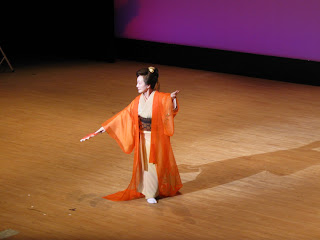
One student invited us to a Charity event that she was a performer in called the Meeting of International Friendship. There was live music and a lot of traditional Japanese and Hawaiian dancing. The costumes were so beautiful and it was so interesting to see all of the different types of dancing.
One of my favourite performances was an Indonesian musical performance. They were playing instruments made of bamboo called angklung. It was so cool. 
It is just a multi-cultural love-fest up in here, and I dig it. Hurray for Education!
Professor Awano started by sharing with us some of the recommendations for Japanese education from the United Nations Convention on the Rights of the Child. One recommendation expressed concern about the highly competitive school environment that exists in Japan. Students have to take entrance exams before being accepted into high school, and even though the birth rate in Japan has been declining, more schools close each year. This puts a tremendous amount of stress on students in Japan. Another recommendation had to do with the increasing number of consultations for ADHD in Japan, which sparked a very engaging conversation between the four of us and Professor Awano about ADHD, learning disabilities and the Alberta system of coding. Japan has separate schools for special needs education (we will be visiting one during our stay) but is slowly moving towards some inclusion, with the introduction of a resource room system. However, there is no extra funding allocated to special needs students. We talked about some of the rewards and challenges of the inclusive practices that Alberta Education is implementing.
Overall, a very stimulating and interesting session.
Now, back to making you extremely jealous.
Sapporo beer factory. Sampling some of Sapporo's finest exports.
Saturday, May 21, 2011
My First Kimono Lesson
Today was memorable for me as I feel honoured to have been fortunate enough to partake in a special piece of Japanese culture-learning to wear a kimono....
Rie, Hono and I pulled up to a house in Sapporo...the garden was immaculate. The bonsai were perfectly trimmed, the flowers luscious and bright as if plucked from a movie. In the doorway of the house stood a woman with jet black hair hanging loosely to her shoulders. She wore a kimono that was picturesque accompanied by a perfectly tied obi. She welcome us in-dozo. We followed her into her living room-we drank matcha. Her living room was very traditional and we sat on our knees on pillows. She told us that she used to be a leading person in the tea ceremonies in Sapporo a few years ago. After we finished our tea, she asked us to follow her upstairs.
We climbed the solid wooden staircase and came across a room with tatami (sp) mats, busts of mannequins wearing kimono`s and a large wardrobe.
She opened the wardrobe, took out a few items and asked Rie and I to change into the kimono undergarments...we did. As we did she took more layers of kimono from the wardrobe and closet. We were ready to begin. Our kimono`s took 15-20 minutes to tie. We watched her every move to ensure we were doing it correctly..she reassured us that we were: `hai, hai, hai.`
When we were finished we looked beautiful in our yukata`s (summer kimono`s: sp). I took a lot of photos as I want to remember this moment. It was so rich, so surreal...
Hopefully I will be able to load a photo soon to share with you...
I was excited to tie my own obi..it is difficult and takes patience but, with the right sensei, anything is possible. I have another lesson before I go home and I cannot wait
<3
Rie, Hono and I pulled up to a house in Sapporo...the garden was immaculate. The bonsai were perfectly trimmed, the flowers luscious and bright as if plucked from a movie. In the doorway of the house stood a woman with jet black hair hanging loosely to her shoulders. She wore a kimono that was picturesque accompanied by a perfectly tied obi. She welcome us in-dozo. We followed her into her living room-we drank matcha. Her living room was very traditional and we sat on our knees on pillows. She told us that she used to be a leading person in the tea ceremonies in Sapporo a few years ago. After we finished our tea, she asked us to follow her upstairs.
We climbed the solid wooden staircase and came across a room with tatami (sp) mats, busts of mannequins wearing kimono`s and a large wardrobe.
She opened the wardrobe, took out a few items and asked Rie and I to change into the kimono undergarments...we did. As we did she took more layers of kimono from the wardrobe and closet. We were ready to begin. Our kimono`s took 15-20 minutes to tie. We watched her every move to ensure we were doing it correctly..she reassured us that we were: `hai, hai, hai.`
When we were finished we looked beautiful in our yukata`s (summer kimono`s: sp). I took a lot of photos as I want to remember this moment. It was so rich, so surreal...
Hopefully I will be able to load a photo soon to share with you...
I was excited to tie my own obi..it is difficult and takes patience but, with the right sensei, anything is possible. I have another lesson before I go home and I cannot wait
<3
Subscribe to:
Posts (Atom)